I spent the morning trying to log in to Instagram, unable to airdrop anything on my computer, cleaning hot sauce off my phone, and changing my shirt after getting chocolate chia seed pudding all over it. I’m not just venting; I am going somewhere with this.
When faced with something not working, I’ve heard this voice in the back of my mind ask, ‘What if it’s not me? What if I’m not the problem?’
It’s like how any conversation about budgeting and the economy derails into me ranting about how the real problem is that billionaires need to pay taxes. I’m bringing this up because I’ve been doing a deep dive into the food industry, and I’m hearing some really wild things repeatedly about where the industry is going and its challenges.
If you’re feeling like things just aren’t getting the results you want, and you have this feeling it’s not you…you’re probably right. But before examining all your efforts, here’s how you can figure out if you’re the problem:
🍋 Talk to your peers and brands that seem to be killing it. You don’t need to request their industry secrets, but if you’re seeing the same challenges, like lack of sales or reduced social reach, then it’s not you.
🍋 Look at the last time your brand was killing it. What was the economy like? What were the trends? What was the landscape like? Your brand or marketing slowing down could be a natural evolution.
🍋 Are you doing the same things you were 2 years ago? If so, that’s likely a problem. You need to be constantly refining, changing, and testing. Your efforts are probably just stale.
🍋 Are you listening to your audience and experts? I can’t tell you the number of times I’ve had brands come to us with a problem and when we point it out, they argue why it has to be done a certain way. Ok, no problem, but you’ll get the same results. You can’t expect a big change if you’re not willing to take the risk of changing.
And if after all this you decide it really isn’t you (and billionaires DO NEED TO PAY TAX) then it’s time to choose how you want to pivot, address, or re-align.
Vancouver summers are legendary. There’s a feeling of not wanting to waste a precious moment of warmth, sunshine, and opportunity in our rainy city.
As much as I love summer and getting outside…I miss my kid being in school, not sweating when I fall asleep, and having an oily, sweaty face ALL THE TIME. I do have a point here: People are as online as ever but we’re often sharing a ton and spending less time scrolling.
So here’s how you can be strategic about your marketing time right now:
🌞 Prepare for your build-up. Think about when you need to be aggressive with your marketing. For many brands, that is during the holidays when it is the noisiest and most expensive to stand out. So start running brand awareness ads months before your big push to build your audience. Think about how you can zig when everyone zags during the holidays.
🌞 You want blue oceans. The idea is that you don’t want to go to the red ocean, where a feeding frenzy is. You want to find a clear place in the sea. Maybe for you, that’s pushing hard in January when everyone is thinking about health and wellness.
🌞 Let it go. You can’t force people to care when they’re checked out. I find people really aren’t ready to accept summer is over until the third week of September. They’re holding onto long weekends and lake days like cold death, and then they’re focused on settling into a new routine. I would almost never recommend having an event in the first couple of weeks of September or a big launch.
🌞 Cut costs where you can. Suppose you’re a food brand that crushes it in December. In that case, you might want to consider cutting back on your marketing in January. Take a breath, re-align, and cut back temporarily if needed. Your audience also needs breathing room if you’ve been doing 2x the regular content and outreach during the holidays. (Your marketing people, too!)
So if you’re reading this during these gorgeous summer days, thank you. I know you’d rather snorkel before rollerblading while eating a hot dog.
🤯 This hack saved me a fortune and it still works!
👇🏼 Steal this strategy!
Experts have recommended that we should be spending an HOUR A DAY engaging on social media. Meaning answering comments, questions, and engaging with other accounts.
Most business owners don’t have time for that and when we started our agency it was expensive to pay my marketers to do that.
Because here’s the thing:
It didn’t require a ton of experience, knowledge or expertise. But it was public-facing which meant it was important. That person had to be available, flexible, but I just couldn’t pay them the rates I payed my marketers.
🙀 So who saved my business?
Stay at home moms. Think about it. Most of my mom friends are educated, dependable, professional, wanted to make some extra cash, but also needed to be flexible and pop in and out whenever they needed.
We still have an engagement team that rocks including stay at home moms who check our accounts throughout the day. I’m not surprised stay at home moms are a secret weapon- what can’t they do?
I’m obsessed with Patagonia‘s story and marketing.
They are living proof that brands can change the world and that by going against a marketing or business playbook, you can become the most trusted brand in America.
So, if you’re more a skimmer than a deep reader, here are some key things you can learn from Patagonia.
⭐ It’s worth it to take a step back to support your vision. I love how they have repeatedly forgone sales and profits to re-engineer products to be less harmful and more holistic with the environment. This supports their why, builds brand loyalty, and invests in their long-term health.
⭐ They are humble. When you’re honest about your journey, you get a lot of forgiveness and leeway from your customers. They repeatedly say they’re not perfect, but they’re always trying to do better, and brand integrity has always remained high.
⭐ Their WHY dictates everything. I will never stop saying that your why should dictate everything from who you hire to what products you put out to how you advertise. Their social media highlights the beautiful outdoors, their website links to their activism campaigns, and their Facebook advertising doesn’t exist.
⭐ People over profits. I will boldly say I have never seen a company go public and have it result in a better product, better experience, or better impact. There is nothing wrong with wanting to go public yourself. I’m sure you could send me a few examples, but Patagonia is about the planet. Period. So instead of going public they gifted 100% of their $3B fortune to the Patagonia Purpose Trust and Holdfast Collective.
The four dreaded words that keep marketers up at night:
“MaKe It Go ViRaL!!!”
Because as any marketer will tell you, it’s almost impossible to control or plan but it IS the ultimate dream. Do something cheaply and get millions and millions of impressions? Ummm…yes please!
The POINT of guerrilla marketing is to go viral. You’re doing something unexpected in unexpected places to catch people’s attention. It’s the ultimate in marketing creativity, and since AI has infiltrated everything, we now have AI guerrilla marketing.
Take a look at this ad from Samsung. It’s not actually being executed outside, but it’s going viral, just like a traditional outdoor campaign that goes viral.
I love this concept because you’re saving yourself the cost of installation, the time spent dealing with city officials, and all the logistics of making this happen in the real world while still getting the benefits of something going viral.
✨ Viral Content. Remember when the Barbie movie was EVERYWHERE? Besides epic partnerships, Barbie took over our social media for a month or two with an image-generator that created custom Barbie posters for everyone and anyone. There’s nothing stopping you from creating something iconic and shareable with an AI generator and creating a template.
✨ Making The Mundane Beautiful. With AI, something as simple and basic as a QR code can become something beautiful and shareable, as brands are now creating unique QR codes that align with their branding and give value to their audience.
✨ Digital Flash Mobs. Brands have been creating digital flash mobs by having their audiences submit digital postcards with thoughts and opinions to be posted at one single time. I’ve seen non-profits create digital protests by sending custom invitations to their followers to show up at specific time and place digitally. You can use an AI chatbox to answer questions to lead your audience through the process.
My advice is to start somewhere when it comes to AI. Add a chatbox to your website, start using ChatGPT to help with captions, or use AI in your social media scheduling program to determine the best times to post and where.
It’s a good thing. It’s a clear sign you’re ready for help. Here’s the thing: marketing is like a second job in addition to entrepreneurship (but with less pizza parties and more existential dread).
You’ve become a pro at running your business so why not bring in the professionals to build your audience? 💼✨
Besides the obvious of taking over figuring out wtf to post, here’s what an agency brings you:
Expertise Galore: These folks eat, sleep, and breathe marketing. They know all the latest trends, algorithms, and secret sauce recipes to make your brand shine.
Bye-Bye, Emotional Labor: Say goodbye to those nights of staring at a blank screen, desperately trying to conjure up engaging content. They’ve got you covered, so you can binge-watch your favorite series guilt-free. 📺🍿
Fresh Perspectives: Sometimes your best ideas need a little outside perspective (like realizing pineapple DOES belong on pizza 🍍🍕). A fresh pair of eyes can make all the difference.
More Time for YOU: Focus on what you love and let the agency handle the rest. Whether it’s perfecting your sourdough recipe, finally finishing that novel, or just enjoying a peaceful cup of coffee – reclaim your time! ☕️📚
So, if you’re ready to trade in your marketing woes for some well-deserved R&R, hit up a marketing agency.
Becoming Vegan Certified: How, and more importantly, Why?
For most of us, veganism isn’t just a passive coincidence or a by-product; it’s a way of life, a pillar of our values, and something we must communicate to our audiences. The term “vegan” refers to a lifestyle choice that involves abstaining from the use of animal products, both in terms of consumption and other aspects of daily life. Veganism includes food and beverages and everyday products, such as cosmetics, clothing, and household products.
This broader scope allows companies in diverse sectors to meet the demand for vegan alternatives and tap into the growing ethical and environmentally conscious consumer market.
A vegan lifestyle emphasizes the avoidance of animal-derived ingredients and takes an ethical stance against the exploitation of animals, including rejecting animal testing in any form. By adopting a vegan lifestyle, individuals actively support the protection and well-being of animals and contribute to reducing environmental impacts associated with animal agriculture. Veganism promotes a compassionate and sustainable approach to living, aligning with principles of animal rights, environmental conservation, and personal health.
There are many ways to let the marketplace know we are vegan and have crafted vegan products but one of the most direct is to become vegan certified.
But why bother getting vegan certified at all? You know your product is vegan, and anyone who can read will also be able to attest that your product is vegan.
Because it’s good business practice.
Clarity and label transparency are just good practices. A vegan certification provides clear and concise information about the ingredients and processes used to create your product, ensuring that consumers can make informed choices about the food they eat. It adds accountability to your product and business. A vegan icon proudly stamped on your label is one of the clearest ways to communicate that fact to the marketplace.
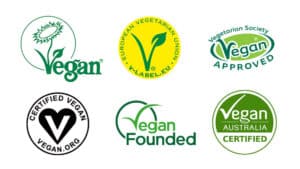
How many of these symbols are an instant recognition that a product will meet your needs as a vegan consumer?
In recent years, there has been significant growth in the demand for vegan products as consumers increasingly seek out alternatives that align with their ethical and environmental values. As a result, more companies recognize the importance of catering to this expanding market by offering vegan options and obtaining vegan certifications. By obtaining vegan certification, companies can demonstrate their commitment to animal welfare, sustainability, and meeting the needs of conscious consumers. It opens new market opportunities and enhances brand reputation as more individuals gravitate towards vegan options.
Vegan certification ensures that products are manufactured without the use of animal ingredients and the testing or exploitation of animals. It provides consumers with the confidence that the products they purchase have undergone strict scrutiny and meet the standards of veganism.
But where is the best place to get your vegan certification? There is a range of options, but what you choose depends on your target audience and what your business aligns with. A cosmetic or beauty product that wants to convey the ethical treatment of living beings may opt for an endorsement from PETA, whereas a food product being sold overseas may want to invest in getting an internationally recognizable logo from BeVeg.
No matter where you decide to get your certification, the first step is to ensure you meet the basic criteria; for a product to be approved for Vegan Certification, it must not contain meat, fish, fowl, animal by-products, eggs or egg products, milk or milk products, honey or honey bee products, insects or products from insects such as silk or dyes, or sugar filtered with bone char or be processed with any animal products or by-products. This includes the contents, the testing phase, and even the cleaning of machinery used for processing.
Next, you must apply for certification; most organizations charge an application fee and an annual fee once approved. This is the cost of doing business, but it’s not too steep, especially if you consider it an investment in your values.
Whether you own a vegan restaurant, lodging establishment, training programs, or consulting business, obtaining certification establishes your commitment to providing vegan-friendly options and services; certification provides a guarantee that resonates with today’s conscious consumers.
The Vegan symbol on your product labels is a powerful marketing tool. It attracts ethically minded consumers seeking animal-free products. While positioning your brand as a trusted provider of ethical and environmentally conscious choices, reinforcing your reputation for sustainability and compassion.
A certification symbol acts as a badge of trust, assuring consumers that your offerings align with their values and dietary preferences.
Some certifications can essentially be bought outright, with few requirements.
Others are more involved processes. This can be more expensive but also result in added benefits, such as assistance in navigating the certification process, audits, training to ensure that businesses can maintain vegan practices effectively, ongoing compliance monitoring, and aid in promoting your business to the certifiers network, which you can leverage to attract more conscious consumers.
Though certification may be another process and another cost, if you are an admin superstar, go for it! It can be a simple procedure. But if you are a mess regarding applications and red tape navigation, go for one of the higher-priced certifications that lend support and guide you through the steps, eliminating the administrative headache.
The fact is that it draws in consumers and works to assist in ending animal exploitation. And that’s your Why.
If business owners could go to therapy with social media, we would.
Your needs are constantly changing. Sometimes, you give us the highest of highs, and sometimes, we’re just confused. Social media is still a game-changer for most brands, but I’ve noticed that there are some unrealistic expectations.
I often need a reminder myself of how to work smarter, not harder, so here is a reminder of what it takes to grow on social and how to manage expectations:
🍋 You have to put the time in. I loved how Erika shared her LinkedIn strategy and what it took for her to be a major player on LinkedIn. But the truth is that I don’t have the capacity for that. My social is still very much a working part of my marketing machine, but I won’t expect 70k followers when I know I can’t put in the time she can. So mitigate your expectations for what you can put in.
🍋 You need to audit your pages regularly. Because social media is constantly changing, you need to keep tabs on what everyone else is doing, how the platform is changing, and what content of yours is performing the best. Then, lean the heck into what’s working.
🍋 Just because something works for someone else doesn’t mean it’s right for you. It’s a bit of a gut punch to see a peer or competitor crushing it on Instagram and not know why it seems to fall flat for you. I remember one client saying that Instagram had never worked but that Pinterest always worked so well for them. Yes! That’s amazing! Lean the heck into what works for you—which depends on your brand, your audience, and how you create content.
🍋 You’re too focused on what social should do for you. The number one problem that I see with brands on social media is that they are too focused on what they want their audience to know—where to buy, what their ingredients are, etc. Remember that you’re there to entertain, inform, or inspire. Basically, offer value through your brand, and your products are a part of that! But no one wants to be sold to constantly.
Remember that social media is about testing and pivoting; there are ebbs and flows.
There’s nothing quite like the humiliation of assuring people that something will be great only to have it fall flat. This can be painful, specifically for marketers. You’ve followed the trends, done the research, know your strategy and positioning, and then got everyone on board.
Then it does f*ck all, and you’re wondering if there’s a major holiday you missed or something.
In these horrible instances, the usual culprits are present: no brand voice, a watered-down campaign, a lack of understanding of the audience, bad timing, or not enough money to create momentum.
But there are some other potential reasons why your marketing isn’t working, so when you have to face the stakeholders whose trust you hard-earned before disappointing them, at least go back with some key learnings.
🍋 Your customers are LIARS. It might sound unfair, but the truth is that everyone is a liar. If you’re building your product, events, or marketing based on what your target SAYS they will do, then you will fail. Money and action talk…talking doesn’t…talk. Any event planner will tell you this because people will swear up and down they will attend an event. Still, in reality, only 30% of people actually follow through.
🍋 You’re taking advice from an expert or your competition. We should always be keeping our finger on the pulse of what’s happening but the truth is we get diminishing returns when copying someone else. Their audience is primed differently, with distinct expectations and needs. Make sure whatever you’re putting out is your own.
🍋 It’s too complicated or not high enough value. People check out immediately with either of these things. I remember putting on a speaker series—it was a series of speakers in one afternoon—but no one really knew what it was, and no matter how hard we tried to educate or dig deeper, people checked out. The core of what I was offering was a little complex.
🍋 What worked before likely won’t work again. Remember how much Instagram Lives were shoved down our throats? Things are changing so fast. Find something you feel is really in your lane and do it your way—YouTube, IG, TikTok, whatever—and don’t make it too dependent on trends if you’re not able to keep up with them.
And listen. Sometimes, things fail to launch, and there is no good reason. Try tweaking before starting from scratch because you might be closer than you think.
💸 Events can be expensive and take over your life. So why bother? Because events can reap a ton of long-term rewards for your brand. There’s a reason brands like Lululemon still do their marathon every year.
Because you’re creating deeper loyalty in person. You’re able to get unparalleled customer research because you can observe what people are saying, where they are hesitating, and what they love. Trust what people do, not what they say.
✨ You should also be building your email list, connecting on a deeper level with your VIP stakeholders, and building other contacts like ambassadors or influencers.
And you should be adding a touchpoint so that you’re reaching new people beyond your usual social media and newsletter efforts. It could be where you’re showing up that has new traffic or the PR you’re getting with your event but it should have a really wide reach to get more people into your funnel.
Remember that above all you need a follow-up plan!